Overview
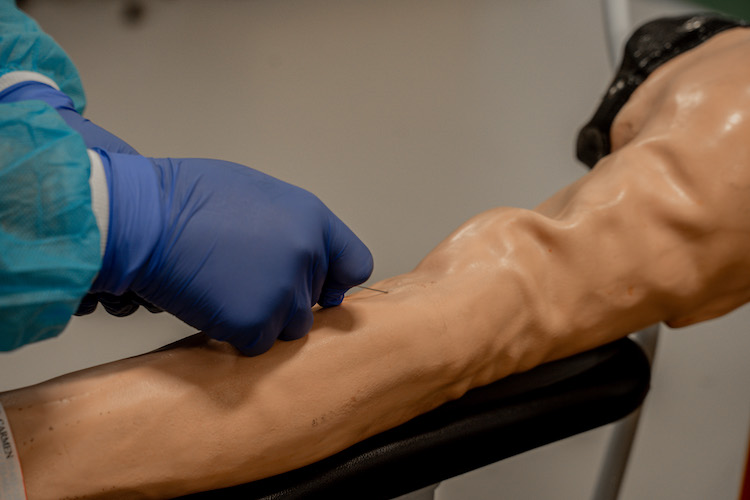
Phlebotomists draw blood for tests, transfusions, research, or blood donations. Phlebotomists work mainly in hospitals, medical and diagnostic laboratories, blood donor centers, and doctor’s offices. Phlebotomists typically enter the occupation with a postsecondary non-degree award from a phlebotomy program. Almost all employers look for phlebotomists who have earned professional certification.
Program Admission Information
Eligibility Requirements
- Apply for admission to SCCC
- Submit official high school transcript or GED scores. Minimum GPA is 2.50.
- Have completed one year of high school science with a final grade of C or higher or equivalent.
- Have completed one year of high school math with a final grade of a C or higher or equivalent.
Additional Requirements
- Criminal Background Check
- Immunizations
Contact the program coordinator or Allied Health department for more information.
Program-specific Costs
Phlebotomy Approximate Costs
Kansas residents in Seward County tuition and fees is $114 per credit hour, Kansas resident tuition and fees is $117 per credit hour, border state tuition and fees are $139 per credit hour, and Non-Kansas resident tuition and fees is $154 per credit hour. Seward Online course tuition and fees is $150 per credit hour.
Tuition (10 hours @ Seward online. 2 hours @ in state) $1,728.00
Background Check $70.00
Liability Insurance $60.00
Textbooks $300.00
Total $2,198.00
Approximate Cost
2026-2027 Financial Aid Cost of Attendance Budgets
(Estimates Based on Full-Time Enrollment)
Expenses included in this Cost of Attendance are outlined by federal law. These are estimates of the total cost of attending SCCC for one year. Cost of Attendance is used to determine each student’s eligibility for financial aid as you may not receive federal aid greater than your cost of attendance. THIS IS NOT YOUR BILL.
Tuition and Fees: Seward County Resident | $4,704 |
| In State | $4,800 |
| Border State | $5,496 |
| Out of State/International | $5,952 |
Books, Course Materials, Supplies and Equipment: | $1,570 |
| Food and Housing: | |
On Campus (SLC) Off Campus With Parents/Relatives | $8,960 $9,160 $5,496 |
| Personal Expenses: | $3,084 |
| Transportation: | $1,552.50 |
| Loan Fees: | $50 |
| Credential & Licensure Costs: | Varies by program/course |
Career Opportunities
Phlebotomist can pursue employment in settings such as:
- Hospitals
- Clinics
- Commercial laboratories
- Public health facilities
- Diagnostic laboratories
Curriculum
Phlebotomy SAPP
The Students as Partners Program (SAPP) for Phlebotomy is an abbreviated certification program that helps students learn the theory and practical skills needed to draw blood from patients for medical testing or other purposes. This includes understanding human anatomy and physiology, particularly the circulatory system, as well as medical terminology, infection control, and safety procedures.
Exclusionary Criteria
To ensure the safety of all patients for whom our allied health students provide care, all allied health students over the age of 18 will be required to complete the criminal background check. If a student is found guilty of any felony crime against a person, the student must meet with the appropriate program director to determine the student’s ability to participate in clinical placement. Students who are unable to complete the clinical component of their respective program will be withdrawn from the program.
The following list of felony crimes against persons will prevent clinical placement for any allied health student:
- Murder in the first degree
- International second-degree murder
- Capital murder
- Domestic battery
- Murder in the first degree
- Aggravated kidnapping
- Murder in the first degree; Conspiracy
- Murder in the second degree (reckless)
- Murder in the first degree; Solicitation
- Voluntary manslaughter
- Kidnapping
- Aggravated robbery
- Aggravated battery on LEO-intentional, great bodily harm
- Injury to a pregnant woman in the commission of a felony
- Aggravated battery – intentional, great bodily harm
- Injury to a pregnant woman in commission of K.S.A. 21-342 (aggravated assault), K.S.A. 21-3413 (a)(1), battery or K.S.A. 21-3517, sexual battery
- Involuntary manslaughter
- Robbery
- Aggravated battery – reckless, great bodily harm
- Aggravated assault on law enforcement officer
- Mistreatment of a dependent adult – physical
- Aggravated assault
- Aggravated interference with parental custody
- Blackmail
- Battery against a correctional officer, youth center office, juvenile detention office or city/county correctional officer/employee
- Aggravated battery – intentional, bodily harm
- Aggravated battery – intentional, physical contact
- Stalking when the offender has a previous conviction within 7 years for stalking the same victim
- Aggravated battery – reckless, bodily harm
- Assisting suicide
- Criminal threat
- Stalking in all other cases
- Interference with parental custody in all other cases
Program Handbook
To view the program handbook, click the button below.
View the handbook
Program Outcomes
Program Outcome: Phlebotomy graduates will demonstrate an average of at least 70% on the Board of Certification exam as calculated by the most recent three year period.
Result: This is a new program so no data is available at this time.
Program Outcome: At least 70% of students who have begun the final half of the phlebotomy program will successfully graduate from the program as calculated by the most recent three year period.
Result: This is a new program so no data is available at this time.
Program Outcome: Phlebotomy graduates will demonstrate an average of at least 70% employment placement rate either through employment in the field or closely related field or continue their education within one year of graduation as calculated by the most recent three year period.
Result: This is a new program so no date is available at this time.